
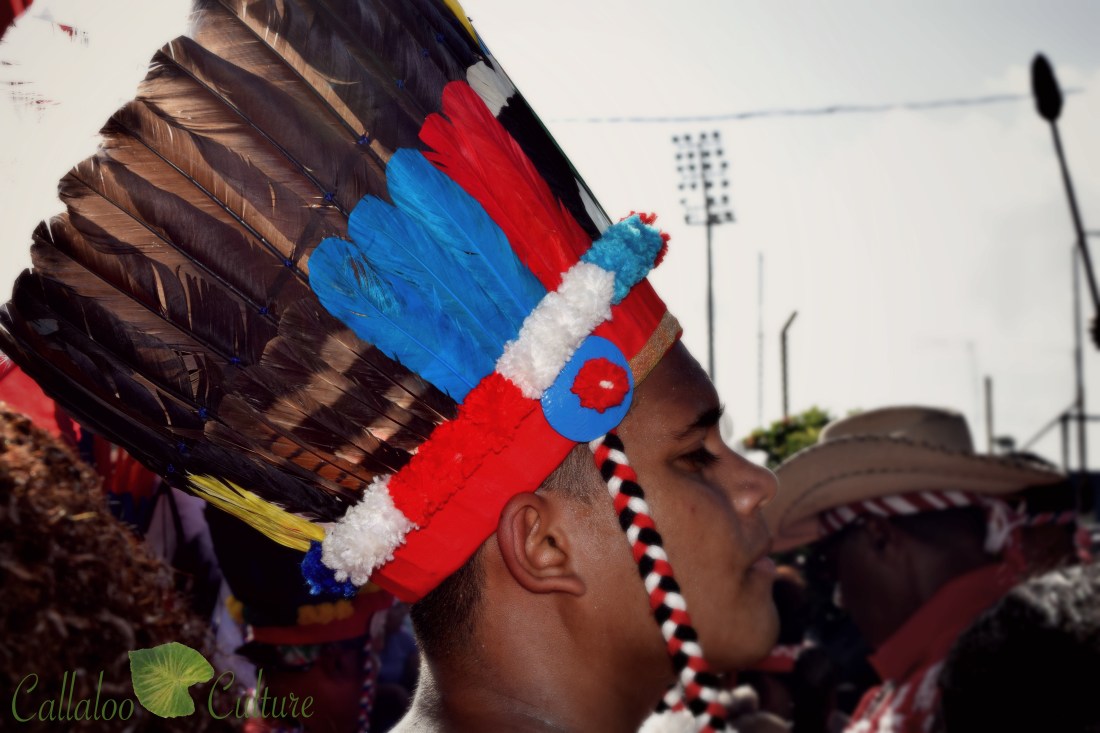
Friday the 13th also known as “Black Friday”. A day that is usually synonymous with black cats, ladders, slasher movies and bad luck. However this Friday the 13th Trinidad and Tobago celebrated along with the First People Community as the government of the day granted them a onetime public holiday. Callaloo Culture was there to witness the opening of the festivities which proceeded outside the Arima velodrome in front of the statue erected in memory of Hyarima the great Carib warrior.
Before I continue, let me set part of the record straight, these indigenous people have been incorrectly named. For years we have referred to them as the Caribs and the Arawaks, let us please give them the respect that they so deserve and address them by their correct names, the Tainos (Arawaks) Kalinagos (Caribs).
This visitor who came to Trinidad to celebrate with our first people waits patiently to contribute to the rituals
Back to my original topic.
The occasion began with the acknowledging of the ancestors. The Tainos and the Kalianagos believe that God can be either male or female energy since nobody has ever seen God. The Kalianago King who was the main officiate of the ceremony, called on both energies to cleanse the grounds before their rituals were performed. This exercise was done with fire and water. Following the cleansing of the grounds a smoke ceremony was performed to honour and give thanks to the ancestors. A Smoke ceremony is an ancient custom among indigenous people which involves the burning of native plants to produce smoke. This is believed to have cleansing properties and the ability to ward off bad spirits.
Offerings to God. As in days of old, plants and flowers were used as offerings for the smoke ceremony
This ritual was no different from ancient days as participants used these elements to make their offerings to God. One of the officiates – the Kalianago King (of Trinidad and Tobago) expressed his joy at the large number of persons who were present to participate and observe these rituals. He indicated that every year on the 14th of October, a few members of the Kalinago and Taino communities would gather at this same location to give thanks and honour the ancestors but because it was not a public holiday the turnout was usually very small as people often had other commitments.
An elderly member of the Kalinago community comes forward to make her offering
After all the offerings were made for the official part of the ceremony, a series of chants and songs were sung by members of the indigenous people. This for me was a pore raising experience, although I have never been exposed to their method of worship, for some reason I felt a sense of calm and peace. Perhaps it is the way in which the chants were done or the slow steady rhythmic beating of the drums this experience is something that would not be forgotten.
After performing her rituals this young lady stands over the smoke seemingly reflecting
The Kalianago King invited members of the public to make their own personal offerings. He warned however that women who are currently experiencing their menstrual cycle should not participate, if they do not heed his warnings they can face serious consequences. A calabash (a Caribbean fruit which insides are usually dug out and shell dried which are primarily used as utensils) filled with water and leaves was placed on the floor besides the offerings and members of the public who chose to give their prayers and offerings to God were instructed to carefully cleanse themselves by washing their hands and face. Many took advantage of this invitation, as people from different walks of life came forward to give their offering each taking a moment to talk to their version of God
This Calabash filled with water and leaves was provided so that persons can wash their hands and face in an effort to cleanse themselves before making offerings to God.
Native people from across the Caribbean and internationally travelled to Trinidad to participate in Friday’s ceremony. There were representatives from Suriname, Guyana, Dominica, St Vincent, Canada and The USA. Which brings me to another point. As I looked around and observed our local indigenous people I noticed that there were not many. Don’t get me wrong, there were lots of people who identify as Kalianago and Taino because of their ancestry and you can look at them and see some small traces and resemblance of our first people. But as for prominent, pure features of the native people these were few and far between. According to the census records of Trinidad and Tobago 2011 the indigenous people account for 0.11% of the population, that is an actual body count of 1,394 persons, among a populace of roughly 1.4 million people, yeah…. Let that sink in. There were many reasons over the years that could have attributed to this startling figure such as, death, migration, interracial breeding and Christopher Columbus (<– BINGO! Stay tuned for my thoughts on Christopher Columbus in a later blog post).
While others chant this young man participates by shaking his chack-chack
Witnessing the rituals for the Indigenous people this year was everything but disappointing. I almost felt like I was in a time capsule as I listened to and observed everything that was done and explained. I am certain that every rite performed was done exactly as they were done centuries ago which amazed me. In spite of all the adversaries that they have faced over the years, they still managed to hold fast to their culture and traditions. I honestly think that we should cherish our remaining indigenous people. They were here first, rightfully Trinidad belongs to them. It is always disheartening for me to see our indigenous in the media lacking something for. Yes, they were granted land, but this was only very recently. There is a whole lot more that the government and the corporate sector can do to assist them. They are an integral part of our history. We literally have a hand full of them left.
Blessings!
Callaloo Culture
For further information check these links
http://cso.gov.tt/census/2011-census-data/
http://trinidad.discover-tt.com/history.html
http://www.santarosafirstpeoples.org/
http://www.newworldencyclopedia.org/entry/Carib
http://caribbean-beat.com/issue-3/people-columbus#axzz4viZxuwGY
http://trinidad.discover-tt.com/history.html
Categories: Uncategorized
 callalooculture.com
While reading your blog I too felt the passion and willingness of our first people to have the general public witness their memorable occasion. I believe my forefathers would have been of either kalinagos or tainos, and for this I appreciated the exposure.
LikeLike